Mail Event
Use mail event when you want to trigger a process flow as soon as a mail server receives the email.
Creating mail event
-
Click Configure > EVENTS > Mail Event.
-
Click Create Mail Event to create a new Mail event.
-
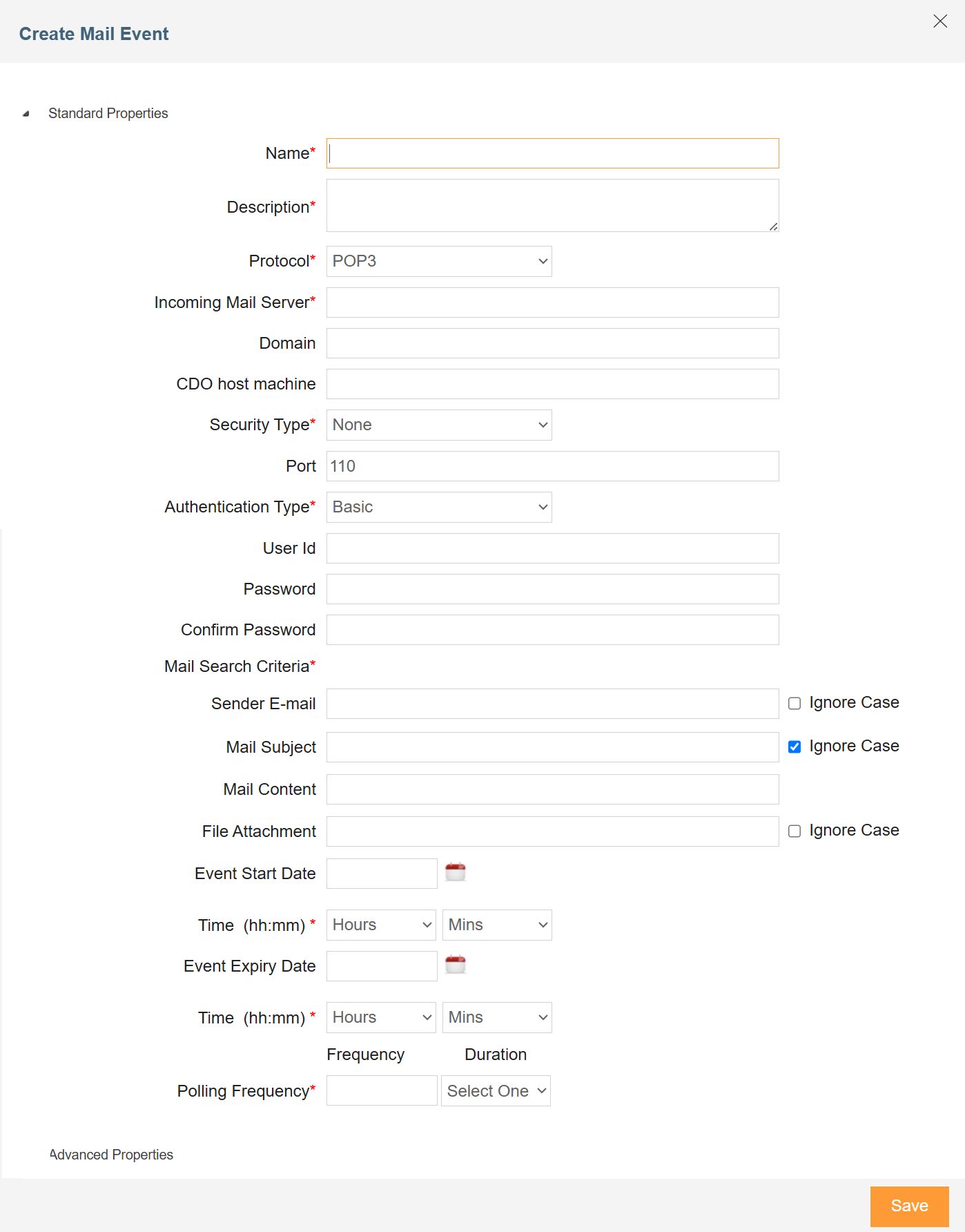
On Create Mail Event window, enter a name and description of the Mail Event.
-
If you select GRAPH API as the protocol then provide the following details:

You can select the Use Config checkbox (if available) to dynamically fetch the values of the fields from a Git repository at runtime using a variable.
<ch:anchor>Field Name</ch:anchor> Description Authentication Type Select the authentication type--Basic or OAuth 2.0.

If GRAPH API is selected as the protocol, the Authentication Type field is disabled for selection with OAuth 2.0 as the default authentication method. - When you select Basic as the Authentication Type, provide the mail server credentials in the User Id, Password, and Confirm Password fields respectively.
You can also use HashiCorp Vault to fetch the secrets (credentials) for User Id and Password. Each secret is maintained as a key-value pair in Hashicorp Vault. Select the checkbox against the respective fields to use Vault to fetch secrets for the fields. Enter the variable in the following format in the field:
${Vault:<Key1>}Where, <Key1> is the key in Hashicorp Vault that is defined for the field.
For example, you need to enter ${Vault:mailEventUserId} in the User Id field, if you have defined maiEventUserId as the key for this field in the Vault. For more details, refer to this page. - When you select OAuth 2.0 as the Authentication Type, you need to provide an OAuth account in the field that follows.
OAuth Account Select one of the available OAuth accounts from this field.

OAuth Account field displays only those OAuth Accounts for which you have selected Use In Mail Activity check box while creating the account. Click here to know how to create an OAuth Account. Mail Search Criteria Select any of the filter criteria: Sender E-mail, Mail Subject, Mail Content, File Attachment.
You can:
- select more than one filter criteria.
- use asterisk and wild cards in the content of the email.
Multiple email ids are separated by comma (,).
Event Start Date Provide the date from which the event should start triggering. The date must be in MM/dd/yyyy format. Time Time when the event will start. Event Expiry Date Provide the date on which the event should stop triggering Time Time when the event will stop. Polling frequency Time interval for the event to check the existence of the email. We recommended minimum Polling Frequency to be more than 60 seconds. - When you select Basic as the Authentication Type, provide the mail server credentials in the User Id, Password, and Confirm Password fields respectively.
-
If you have selected POP3 or IMAP4 as the protocol, provide the details for the fields listed in the table below, followed by those mentioned above.
Field Name Description Incoming Mail Server Incoming mail server address Domain Enter the domain where the CDO host machine belongs. CDO host machine Enter the name of the CDO host machine to interact with Microsoft exchange server and Outlook data. Security Type Protocol that provide data encryption and authentication between applications and servers in scenarios where that data is being sent across an insecure network. The available options are SSL, TLS, None. Supported TLS version is 1.2. Port Port number of the incoming mail server. Based on the selected protocol, the default port number for POP3 and IMAP4 protocol is displayed in this field. -
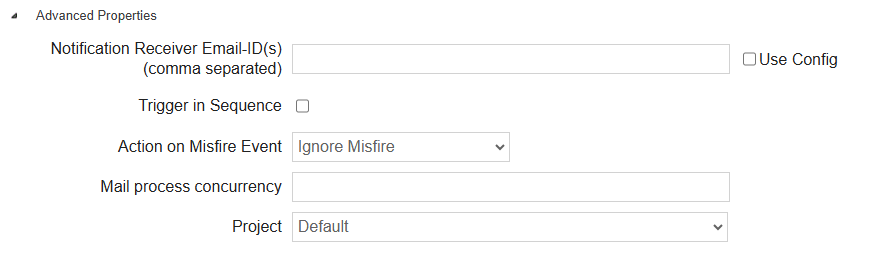
Expand Advanced Properties to view the advanced properties of an Mail Event.
-
Type the email-id in the Notification Receiver Email-ID(s) (comma separated) to receive error emails related to this Mail event.
-
Select Trigger in Sequence check box to trigger the associated process flow in a sequential manner. If you do not select the Trigger in Sequence checkbox then the associated process flow will trigger concurrently.
-
If you want to enable misfire handling for your event then, select the Run Once option from the Action on Misfire Event drop-down list. If you do not wish to enable misfire handling for your file event then, select the Ignore Misfire option.
The Run Once option will run only one collective instance of all the misfires for a particular event. Whereas the Ignore Misfire option will not run a misfired event. -
If a large number of e-mails in the mailbox is meeting the search criteria, then all the e-mails will be processed at a time. If you want to limit the number of e-mails to be processed at a time with this event, type the specified value in the Mail Process Concurrency field.
Mail event will process only the specified number of e-mails at a time, and the remaining e-mails will process based on the next polling frequency. E-mails are processed on First In First Out (FIFO) basis.
-
Select the Project from the drop-down list of Project.
-
Click Save.
The Mail Event gets listed on the Mail Event Manage page.If a mail event is deactivated and then activated again, it will trigger an event for an existing email. A mail event can trigger multiple process flows at a time. Each process flow uses a mail source. When multiple process flows use a mail source at a time, errors can occur.
Therefore, it is advisable to limit the number of process flows triggered by a mail event. You can also set the number of retries and the sleep time between each retry, in case an error occurs when using a mailbox.
- You can sort the Mail Events listed on the Mail Event Manage page by clicking
 next to the required column and then selecting Sort Ascending or Sort Descending as per your need.
 - You can also hide or show a column on the Mail Event Manage page. To do so, click next to a column and then select Columns to choose the columns to be displayed or hidden from the following list:
- Actions
- ID
- NAME
- DESCRIPTION
- PROJECT
- OWNER
- MODIFIED
- Actions
- You can sort the Mail Events listed on the Mail Event Manage page by clicking